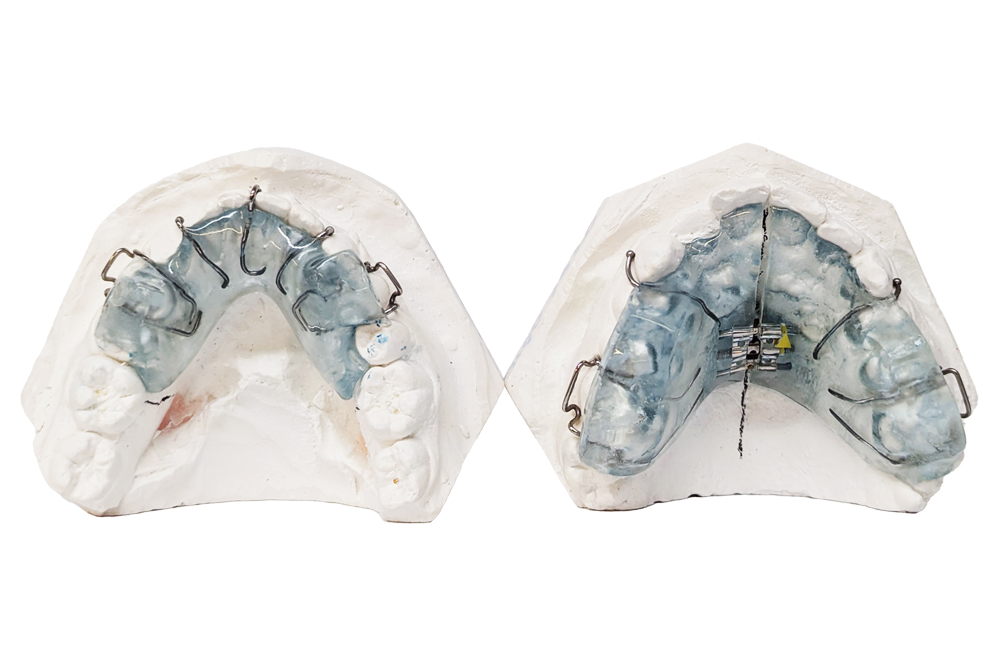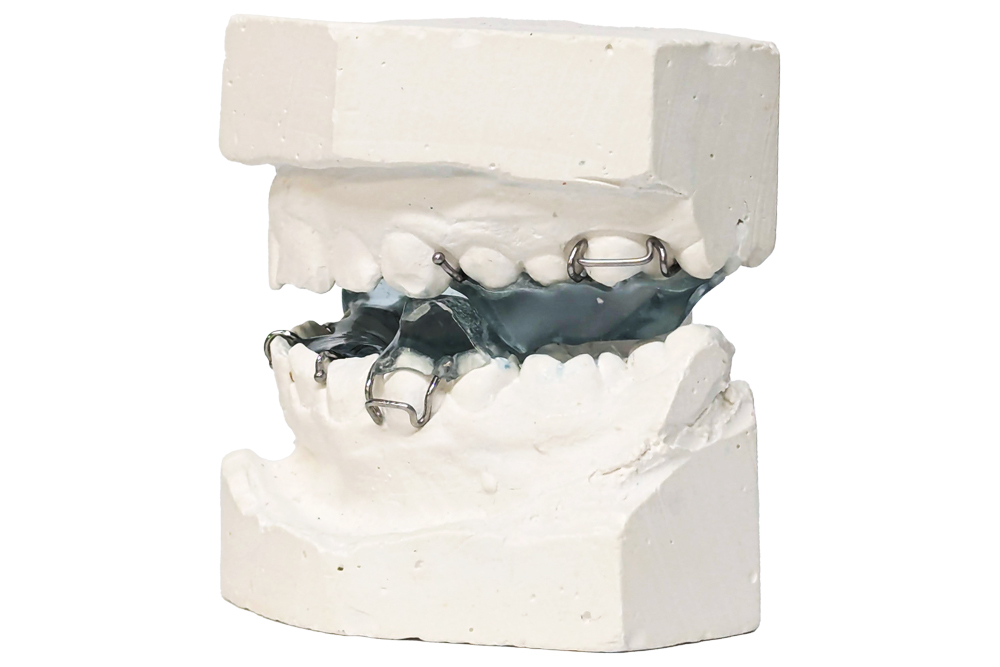
Removable appliances correct crooked teeth. Some of the components within these appliances consist of springs such as T Springs, Cantilever Springs or Palatal Finger Springs. There can also be screws such as expansion screws, piston screws, three dimensional screws etc. in addition to other components to aid retention and provide various movements. All of these are determined, created and fitted ‘in-house’ at Wells Orthodontics.
Cantilever Springs are simple and efficient, with several distinct clinical advantages over continuous arch wires. Knowing the force level and the distance between the two attachment sites, we can quickly calculate all the forces and movements involved. Reactivations are needed less frequently. The cantilevers may be utilised in all the planes of space, both buccally (toward the cheeks) and lingually (toward the tongue) to correct the malocclusion.
Palatal Finger Springs are often used to tip teeth in a mesiodistal (more central) direction.
T Spring is used for the buccal movement of a single premolar or molar tooth. Good retention is required to resist the displacing effect of the spring. Activation is by pulling the spring away from the acrylic at an angle of 45°.
Screws are less versatile than springs, as the direction of tooth movement is determined by the position of the screw in the appliance. They are also bulkier. However, a screw appliance may be useful when a number of teeth are to be moved together (for example in an appliance to expand the upper arch). There are basically two types of screw. The most commonly used type consists of two halves on a threaded central cylinder, turned by means of a key which separates the two halves by a predetermined distance, usually about 0.2 mm for each quarter turn. The other variety is the spring-loaded piston screw, which is activated by moving the whole screw assembly forwards by means of a screwdriver.